
Destination
Kenya Mountain Climbing Safaris
MOUNT KENYA
Straddling the equator, Mount Kenya rises to 5,199m (17,058 ft), making it Kenya's highest mountain and Africa's second highest after Kilimanjaro. The entire area above the 3,200m contour is protected as a national park, and the mountain's dramatic beauty draws hikers, climbers, and nature lovers alike.
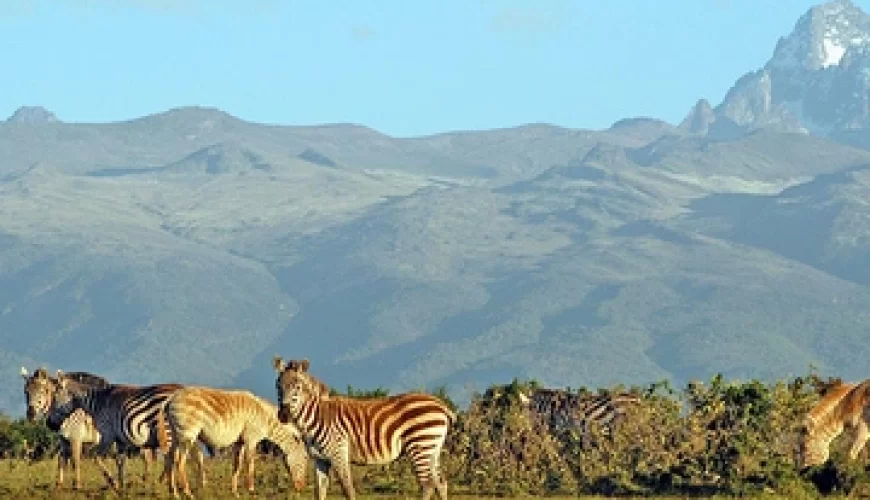
The mountain unfolds in distinct ecological zones as altitude increases. Dry upland forest gives way to true montane forest of cedar and podo from around 2,000m, followed by dense bamboo stands from 2,500m. Higher still, moss-draped trees and open glades mark the upper forest line, before giving way to high-altitude heath scattered with African sage, protea, and helichrysum shrubs above 3,000m. The summit zone beyond 3,500m is stark moorland, home to hardy species like Zebra and Eland.
This range of habitats supports a striking variety of wildlife. Visitors may spot black-and-white Colobus and Sykes Monkeys, Buffalo, Elephant, Bushbuck, Leopard, and the elusive Bongo Antelope, along with rarer species such as the Sunni Buck, Mount Kenya Mole Shrew, and various Owls. Occasional sightings of Albino Zebra have also been recorded, and at least 11 species found here are unique to the mountain. Melting snow and glaciers feed several major rivers, including the Tana, Kenya's longest river and a key source of hydroelectric power.
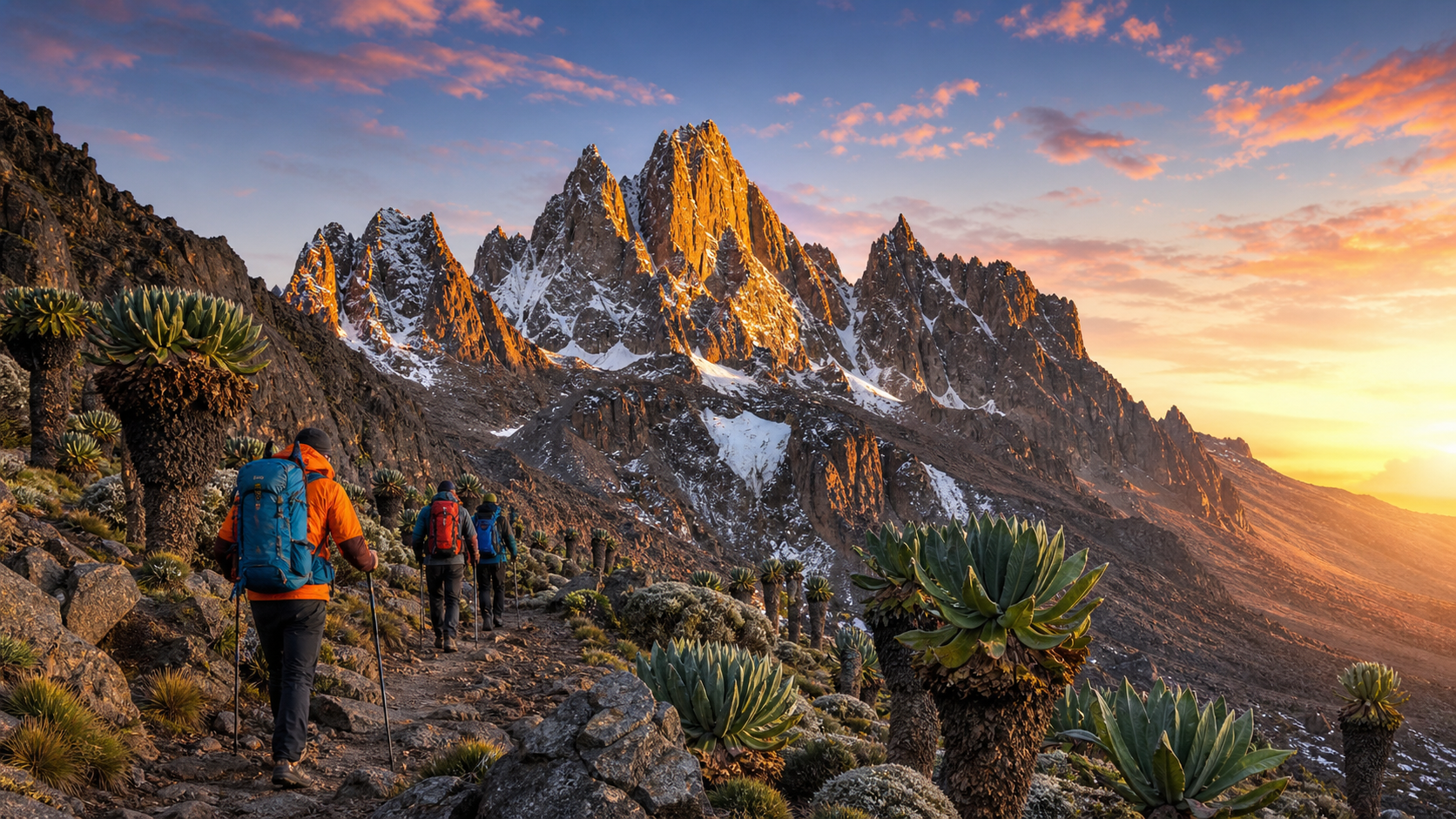
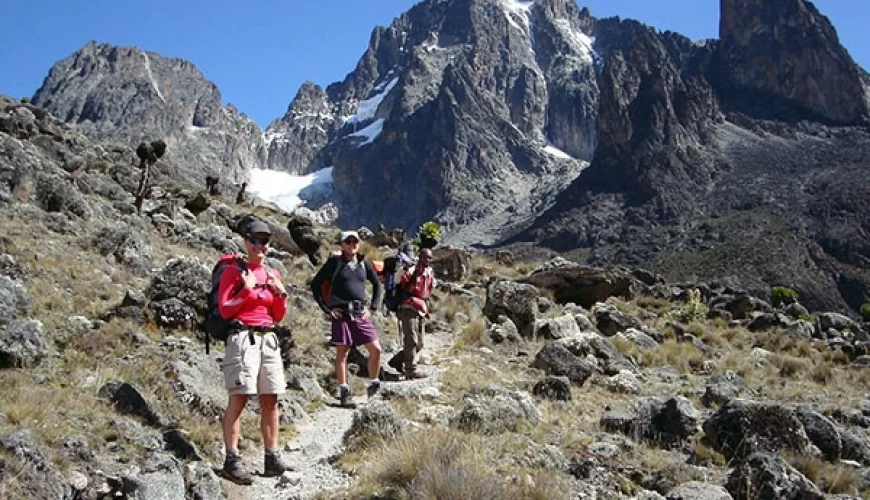
Most visitors trek to Point Lenana at 4,985m, a rewarding but achievable climb for anyone adventurous; no technical climbing experience required. For experienced mountaineers, the higher peaks of Batian and Nelion offer a genuine rock-climbing challenge. The classic hut-to-hut circuit around the mountain remains the most popular way to experience its landscapes, offering sweeping, humbling vistas at every turn. The best months to visit are January and February, and again from late August through September, when trekking conditions are at their clearest.
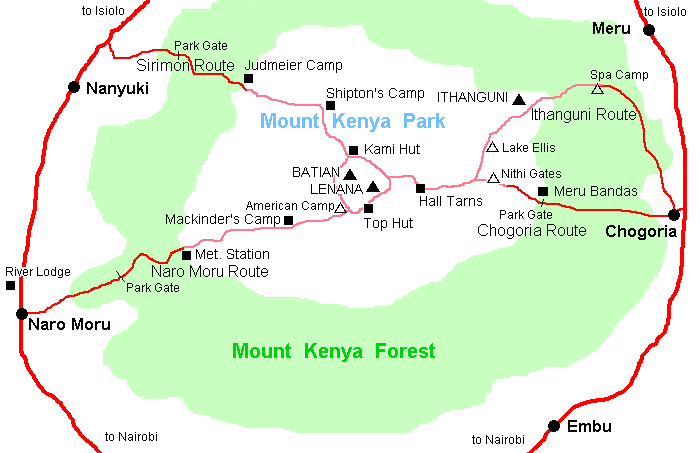
Naro Moru Route
The Naro Moru Route is the fastest and most popular way up Mount Kenya, favored by many tour operators guiding clients to Point Lenana. Its direct path up the mountain makes for an efficient ascent, and a well-paced 5-day itinerary allows plenty of time to acclimatize safely and enjoy a successful climb.
That said, the route's steepness means preparation matters. Hikers should be ready for a demanding stretch through moorland nicknamed the "Vertical Bog," which can turn into a slippery, muddy slog after rain, and a long scree slope leading up to the Austrian Hut that requires sturdy footing and steady pacing. With the right gear, a good guide, and a sensible schedule, most fit trekkers handle these sections without issue.
Sirimon Route
The Sirimon Route is widely regarded as the most scenic way up Mount Kenya, climbing the drier northwest side of the mountain near Nanyuki. The path leads through forest before opening onto a wide ridge approach to the summit area, offering some of the finest walking on the mountain. Access to the trailhead is good, and the bunkhouse facilities here are considered the best on this side of Mount Kenya.
This route suits energetic hikers looking for a moderate, well-marked trek, with manned accommodation huts at each overnight stop making logistics straightforward. It's a popular choice for those with limited time, such as hikers on a weekend break, since it can be completed relatively quickly. Attempting the summit and descending all the way to the Sirimon road head on the same day (Day 3) is achievable but demanding, and best suited to fit, well-prepared trekkers.
Because the route follows the same trail up and down, it works particularly well for larger groups. Anyone unable to reach the summit can simply wait at a lower camp and rejoin the rest of the party after the summit attempt, making it a flexible option for mixed-ability teams.
Chogoria Route
The Chogoria Route is widely considered the most scenic and dramatic of Mount Kenya's three main routes. It winds past the enchanting Hall Tarns, skirts the sheer cliffs of the spectacular Gorges Valley, and offers stunning views over Lake Michelson, with the towering rock buttress known as The Temple overlooking the lake nearby. The route begins near Chogoria town and climbs steadily toward the peaks circuit.
The 32km stretch from the forest gate to the park gate is often covered by vehicle, though walking is also possible for those with extra time. This lower section teems with wildlife, including Elephant, Buffalo, and Leopard, alongside troops of Monkeys in the trees and columns of safari ants crossing the track. The road can be rough in places, so careful driving (or sturdy footwear if walking) is recommended.
Near the park gate, the trail enters a striking bamboo zone before passing through rosewood forest draped in hanging lichens. A short detour near the trailhead leads to a small bridge over the Nithi stream, and following the stream downriver brings hikers to The Gates Waterfall. Further along, the main path splits toward Mugi Hill and Lake Ellis, while the primary route continues up a ridge with sweeping views across the Gorges Valley toward Delamere and Macmillan Peaks.
As the trail approaches the upper mountain, it crosses the flat head of the Nithi River before the terrain steepens. From here, hikers can branch west toward Simba Col or southwest toward Square Tarn, both linking into the Peak Circuit Route.
Climbing Mt. Kenya Summit: In Sirimon & Out Chogoria Route
"A Scenic Combination"
This itinerary combines the two most scenic routes on Mount Kenya, taking hikers up through Sirimon's lush forests and U-shaped valleys, then down via Chogoria's dramatic landscape, featuring The Temple, mushroom-shaped rock formations, and the sweeping Gorges Valley. Along the way, trekkers experience a striking contrast in microclimates, with Chogoria noticeably wetter and mistier than the drier Sirimon side.
The standard itinerary includes one mandatory night of camping at Minto's Hut on Day 3, with the remaining nights spent in huts along the route for added comfort. This route can be adjusted to 4, 6, or 7 days depending on your pace and preferences.
Climbing Mt. Kenya Summit: In Chogoria & Out Sirimon Route Transverse
"A True Contrast"
This itinerary takes hikers up the Chogoria route and down via Sirimon, offering a genuine contrast in scenery, terrain, and pace. The ascent to the base of the high peaks is steady and longer than other routes, making it a solid test of fitness, while giant groundsels line the steeper sections of the Chogoria approach, adding to the route's dramatic character. The descent through Sirimon, by contrast, is more gradual and comfortable, offering a gentler close to the trek.
The standard itinerary includes one mandatory night of camping at Minto's Hut on Day 2, with the remaining nights spent in lodges available along the route unless camping is preferred throughout. This route can be adjusted to 4, 6, or 7 days depending on your pace and preferences.
Climbing Mt. Kenya Summit: Sirimon Route
"A Gradual Ascent"
The Sirimon route offers a reasonably gradual trek to the summit, with manned mountain huts strategically positioned at each overnight stop, so camping is optional rather than required. This makes it one of the easiest short itineraries on Mount Kenya, and a popular choice for those attempting to reach an altitude above 4,000m for the first time.
The route's fixed up-and-down trail also makes it ideal for larger trekking groups. Anyone unable to reach the summit can simply wait at a lower camp, allowing the whole group to reunite and descend together once the summit attempt is complete. This itinerary can be adjusted to 5 or 6 days depending on your pace and preferences.
Climbing Mt. Kenya Summit: Naro Moru Route
The Naro Moru route offers a popular, moderate hike to the summit, following a straightforward path with manned accommodation huts strategically positioned at each overnight stop, including the well-known Mackinder's Camp at 4,200m. It's a great option for energetic hikers with limited time, including those fitting the climb into a weekend break, and it doubles as the shortest and most direct way up the mountain, making it the fastest route to Point Lenana.
The trail climbs steadily through the Teleki Valley, passing the steep, boggy stretch of moorland known as the "Vertical Bog," which can turn slippery after rain. From Mackinder's Camp, the final push to Point Lenana crosses a long scree slope leading up to the Austrian Hut before the summit approach.
The route's fixed up-and-down trail also makes it convenient for larger trekking groups. Anyone unable to reach the summit can wait behind at a lower camp, allowing the group to reunite and descend together once the summit attempt is complete.
Additional Information
NB: Due to the unpredictability of weather around the Summit, we sometimes allow for an extra Summit day thus extending the climb.
What you need to know
- You'll carry only a small daypack with your personal essentials, while porters handle your backpack, sleeping bag, clothing, food, and kitchen gear for the duration of the climb.
- An experienced Mount Kenya guide leads the group throughout the trek. Nights are spent in mountain huts higher up, and in small tents with foam mattresses at the lower foothill camps.
- In addition to your usual travel items, we recommend bringing a medium-sized backpack, a warm sleeping bag, layered warm clothing, sturdy hiking boots, a waterproof rain jacket or suit, sunglasses, and sunscreen.
What is included
- Transport from Nairobi to your hotel and park gate
- Hotel on your first and last night
- All food starting with evening meal on the first day and ending with breakfast on the last day
- Services of a mountain guide & porters
- All hut fees
- Camping equipment
- Acclimatization tour to the equator
Mt. Kenya Kit List
This list covers the equipment and clothing recommended for your Mount Kenya trek and safari. Your main bags will be carried by vehicle or porters throughout the trip, so you'll only need to carry a lightweight day-pack while walking.
- Day pack: Your day-pack should be large enough to carry spare clothes, waterproofs, a camera, lunch, and drinks for the day's walking. Your main bag should be a large kit bag or, ideally, a rucksack, since these are easier for porters to carry, and should weigh less than 16kg for the Mount Kenya section. A light spare kit-bag is also useful for storing any gear you won't need on the mountain, which can be left behind at the lodge or vehicle
- Sleeping bag: A good 4-season bag is essential, as temperatures can drop to minus 10°C higher up on Mount Kenya. If you only have a 3-season bag, a quality liner can add enough extra warmth to make it suitable for the trek. A full-length zip is also useful, allowing you to ventilate the bag on warmer nights lower down the mountain.
- Sleeping mat: A good sleeping mat, such as a Karrimat or a non-slip Thermarest, helps insulate you from the cold ground and adds extra comfort overnight.
- Water bottle: A 1-litre bottle is usually sufficient, though a 1.5-litre size is worth considering if you tend to drink more. Purifying tablets or iodine drops are recommended for treating water on the mountain, and a juice drink powder can help mask the taste if needed.
- Torch: Bring a reliable torch along with spare bulbs and batteries. A head torch is especially useful for hands-free walking or camp tasks, though not essential, and a small spare torch is worth packing as a backup in case your main one fails.
- Walking pole(s): Many trekkers find these highly useful for stability and reducing strain on the knees, especially on descents, though others find them awkward to manage. It's worth trying a pole out on a local walk or hike before the trip to see if it suits your style.
- Camera: Bring spare batteries, a memory card or two, and a cleaning kit for your camera or phone, along with a dust-proof bag to protect your gear from the mountain's dry, dusty conditions.
- Clothing: The following clothing list is provided as a guideline only. Your clothing should give you enough flexibility to cope with the wide range of weather conditions you may encounter during the trip, from warm lowland forest to freezing summit temperatures.
Pack a mix of everyday and technical layers to handle the wide temperature range on the mountain. For general wear, bring underwear, light cotton or poly-cotton items, T-shirts, a long-sleeved shirt, a sweatshirt, and trousers or a skirt, along with comfortable walking socks. For colder or wetter days, add thermal base layers (a next-to-skin vest and long johns), a warm pullover or fleece, and a thick jacket such as fleece, fibre-pile, or a pile-and-Pertex mix, topped with a waterproof, windproof jacket (or cagoule) and over-trousers.
For walking, bring well broken-in walking boots, plus a lighter pair of thick-soled trainers or light walking shoes for camp use, and sandals or flip-flops for relaxing in the evenings. Walking trousers, breeches, or shorts work well on the trail, and gaiters are useful for keeping out stones, seeds, and scratches. A tracksuit is handy for evenings in camp or as an extra warm layer when needed.
Round out your kit with sun protection and accessories: sunglasses, a packable sun hat, a warm hat or balaclava, warm gloves, a scarf or neckerchief, and a swimming costume if you plan to use any lodge pools along the way.
Other Kit
Personal essentials such as a towel, toilet kit, spare glasses, and a personal first aid kit (sticking plasters, lint, antiseptic cream, aspirin or paracetamol, antihistamines, malaria pills, and any personal medication) are all worth packing. Sun cream, insect repellent, lip salve, wet wipes, and a small sewing kit round out your personal care items.
For the trek itself, binoculars are handy for spotting birds and wildlife, and a plant, bird, or wildlife guidebook adds extra interest along the way. A wristwatch with an alarm function is useful for early starts, and packing your gear in reusable dry bags or waterproof stuff sacks inside your rucksack, helps keep out rain and dust.
Documents
Keep your passport, a photocopy of the main passport page, travel insurance certificate, and any payment cards or cash securely stored in a money belt or pouch. A separate wallet is useful for day-to-day spending, and a small notebook or diary is a nice way to record memories of the trek.
If you have any spare clothing, boots, or gear you no longer need, and some unused baggage allowance, consider bringing them along to donate to our local staff, including porters and guides. It's a small gesture that goes a long way and is always deeply appreciated by the team supporting your climb.
Destination Gallery
Kenya Mountain Climbing Safaris Highlights
Park
Mount Kenya National Park
Grade
B- moderate. Up to 6.5 hours/ 15 miles per day
Approximate Trekking Distance
77 Kilometers
Start & End
Nairobi
Departure Day
Any Day
Accommodation
Standard Lodge at mountain base and tent while trekking
Minimum number of participants
2 (Notify us if travelling alone)
Activities
Hiking & trekking, tree naming, bird watch, wildlife encounter, photography and beautiful scenery views
Parks & Reserves in Kenya Mountain Climbing Safaris
View all parks & reserves →
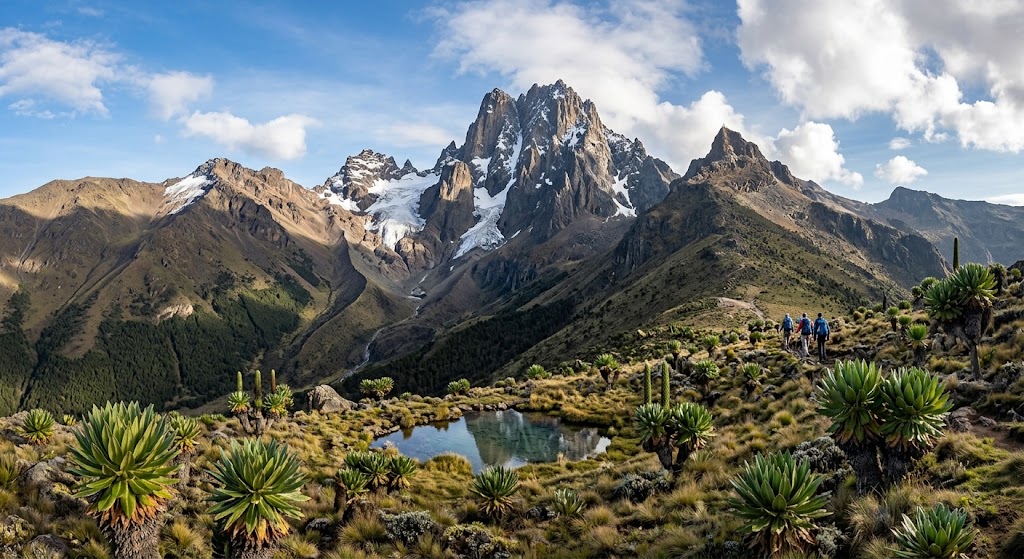
Mt. Kenya National Park
Ascend through an astonishing sequence of worlds to the very crown of Kenya; a mystical, glacier-clad ancient volcano. Here, gi...
View park →Safaris in Kenya Mountain Climbing Safaris
Hotels in Kenya Mountain Climbing Safaris
Activities